Original Compositions
Explore the works by Aidan H.X. Zhou, and watch the performances of the works below.
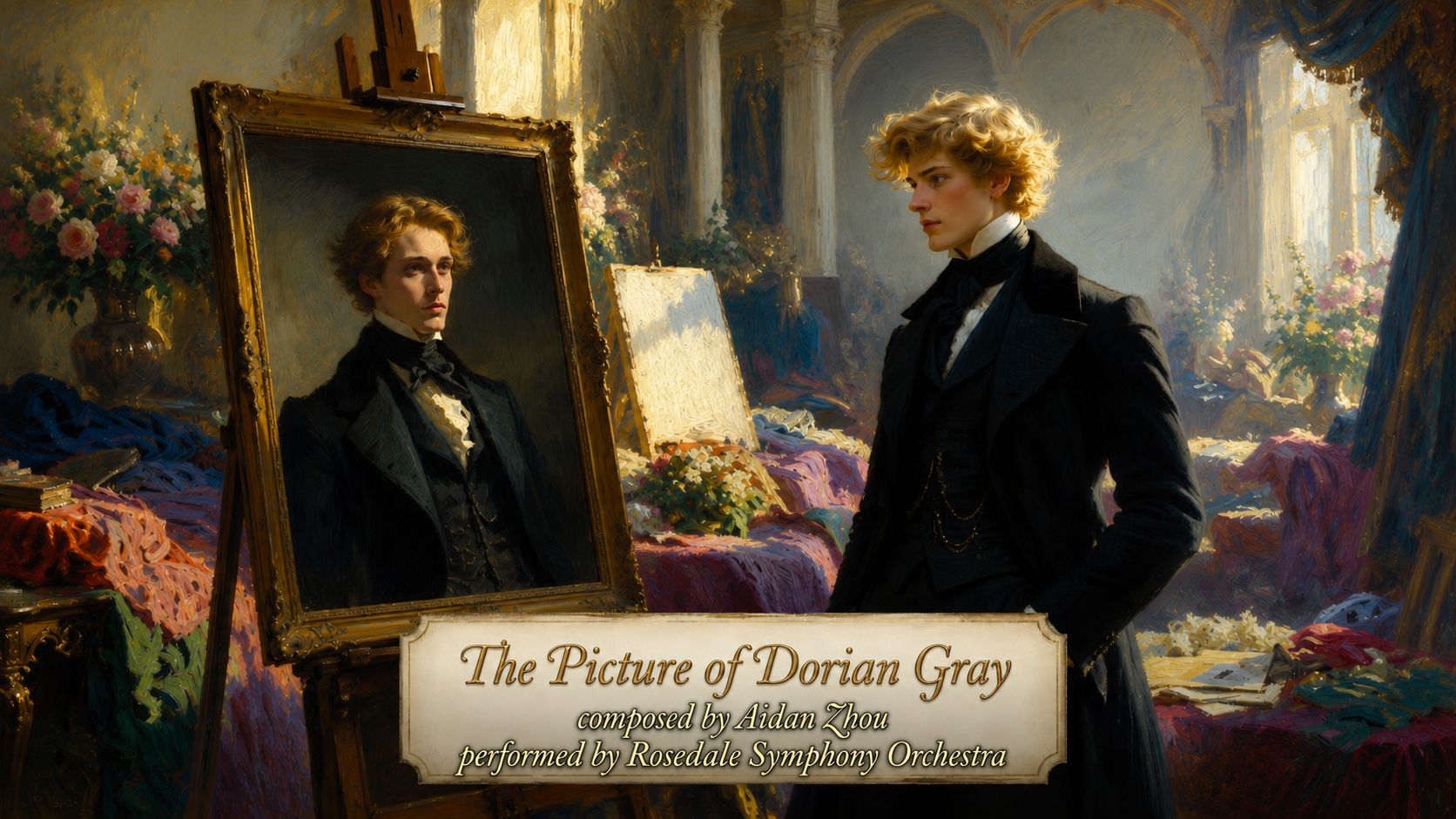
The Picture of Dorian Gray
Inspired by Oscar Wilde’s The Picture of Dorian Gray, this piece shows the life of a man who trades his soul for eternal youth. While his hidden portrait slowly rots and decays over 17 years, Dorian remains young and beautiful. When he finally sees the withered painting, in complete anguish, he kills the painter and stabs the portrait, killing himself. The portrait then returns to its previous charm. The music (a theme and variations) shows Dorian's transformation as the music gets more and more dissonant until he stabs the portrait. In this piece's haunting conclusion, it shows the return of the painting's charm with the glimmer of a glockenspiel and the purity of a flute. ~ July 2025
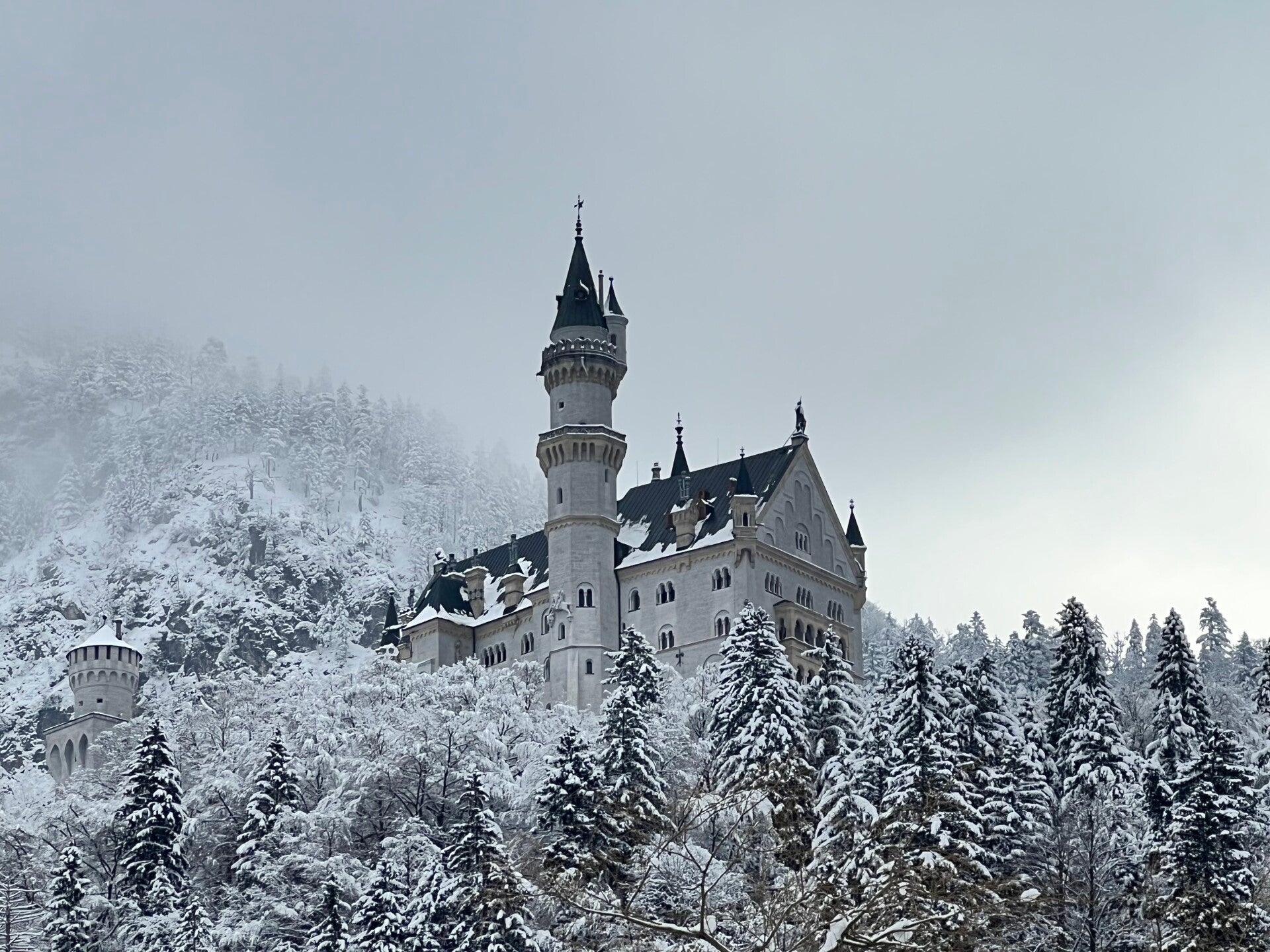
Passacaglia
The Passacaglia is a musical form usually written in 3/4 time that traditionally begins with a basso ostinato ("stubborn bass"), a repeating bass theme. As the piece progresses, this theme is modified and transformed, to build variations. Notably, the theme doesn't have to stay in the bass; it can move to any voice. In fact, as long as the spirit of the variation is recognizable, the original theme can even disappear entirely! This music perfectly captures the landscape and history of Neuschwanstein Castle in Germany, so the music is combined with the photos from my trip to bring the story to life. ~ May 2023
Piano Trio in G Minor
This piece was composed for piano, violin, and viola. It uses fiery tremolos, lyrical melodies, and sudden shifts in character and dynamics to create a dramatic piece of music. The piece is in ternary (ABA1) form. The A section is in a passionate G minor with tremolos in the string sections, a sweeping melody, and subtle, syncopated accompaniment. The A section is contrasted by a much more light, but lyrical B section set in the remote key of A-flat major. Here, all the instruments play a part in constructing a lyrical melody, acting as counter-melodies to each other. However, this expression is short-lived, as the music transitions back into G minor through fragments of material from the B section. In the A1 section, the A section's theme is played with the themes from the B section (this time, in G minor). Quickly, they lead to the Coda ("tail") of the piece. The Coda keeps the tremolos that were part of the A section before it, but this time, it serves as the ultimate conclusion to the piece. ~ August 2024
Brass Quintet in F Minor ("Promenade")
This piece was an arrangement of the earlier Sonata in F minor that I wrote, but arranged into a Brass Quintet for an event. This piece's stepwise rhythm in the time of 3/4 reflects the motion of walking, and hence the name. The consistent rhythm of long-short in the 1st trumpet and short-long in the others (2nd trumpet,french horn, Thombone and Tuba) reveals 3 steady pulses. Since this piece is in Sonata form, there are 2 main themes that undergo transformation, and 3 main sections — the Exposition, Development (middle section), and Recapitulation. In the exposition, both themes show the stepwise rhythm mentioned earlier, with the exception of a triplet passage in the second theme. In the development, both themes, as well as the triplet passage, are transformed, letting the music modulate to D flat major, F major, and A flat major, before eventually returning to F minor in the Recapitulation. In the Recapitulation, a final juxtaposition to E minor, then back to F minor, leads to the coda. A new triplet figure develops, serving as its basis, eventually leading to a tierce de Picardi in F major. ~ September 2023
Finale simulation

Beach Variations
The “Beach Variations” are a group of variations. Their light and happy character reflect the scenery and personality of a beach. In total, there are five variations, a theme, and a Finale. Each variation includes a different modification of the theme, some more complex than others. ~ October 2022
Aidan Zhou, piano
Intermezzo for String Quartet
Inspired by lyrical pieces by Brahms, this string quartet reflects the lyricism of his pieces — in particular, the Intermezzos. It consists of two main themes. The first theme, in D major, is texturally compact with a melody in the first violin, followed by arpeggios that flow up and down the registers of the second violin. The second theme, in the remote key of F major, inspired by chorales and cantatas, is a melody with four voices, which is then made increasingly elaborate with passages in the cello and viola and chromatic scales in the second violin. Eventually, it modulates to the tragic D minor before returning to D major. The Coda makes use of the pizzicato strings as the piece comes to a close. ~ June 2024

Canon in B-flat Major
Contrary to its love-associated nature, as shown in Pachelbel's Canon in D, the canon is actually a form of counterpoint that makes voices strictly follow each other. This piece, was one of my earliest compositions, and it is a simple canon, at only two voices. Although it sounds easygoing and simple, composing it involved a struggle to avoid dissonances and parallels. ~ August 2022
Aidan Zhou, piano
Mazurka in D Major
This lighthearted dance shows the elements of the Polish mazurka — a dance in 3 with dotted notes and emphasis on the weak beats of 2 and 3. It uses the famous descending 5-6 chord progression, and the dotted rhythms of the entire piece reflect its lighthearted nature while remaining true to its Polish roots. ~ December 2021
Aidan Zhou, Piano
Hot Air Balloon
This piece is inspired by a Hot Air Balloon (hence the title). It features a pedal point on G in the left hand that gives the entire piece a sense of weightlessness and lightness, just like a hot air balloon. The entire melody is made of a single 7-note motive, and it serves as a basis of the right hand. In the end, the shimmering melody in the high register fades into nothingness, portraying the hot air balloon as it fades and floats away. ~ July 2021
Aidan Zhou, piano